-
why?
-
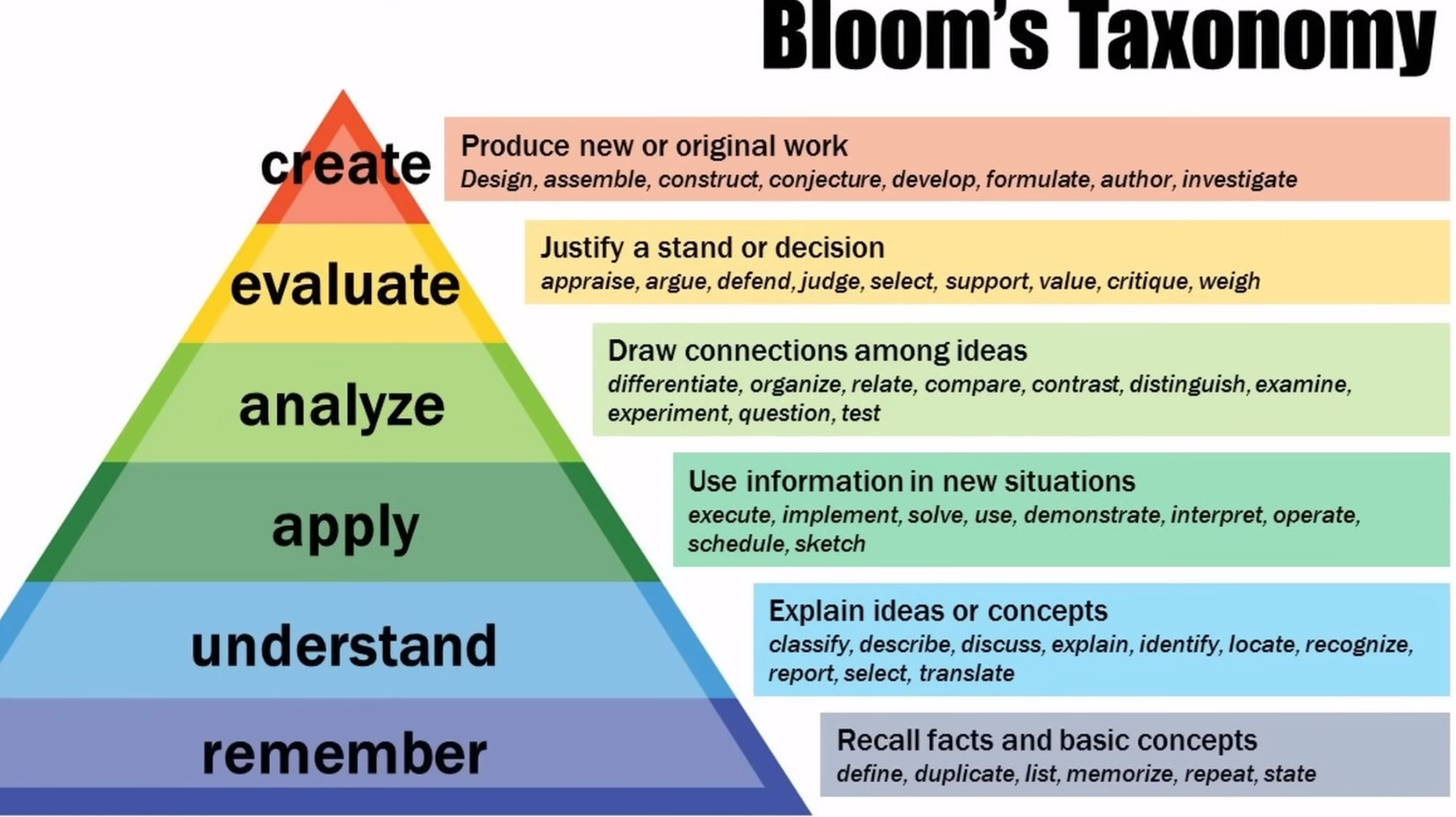
Bloom’s taxonomy
- Always try to start from the highest level
- outcomes from lower levels will be included
- Create - creating new info, innovating on small/large scale
- make ur own frameworks/solutions against a problem
- Predicting
- Predict/Evaluate - scenarios - past/present/future
- criterias - prioritize/assign value, pro/cons
- conclusions - defend your choices HT Aurgument
- context - take into account ur/others’ existing knowledge
- Analyze “CRED”
- Chunking
- Relate
- Extract - succint keypoints & abstraction (patterns) to discover new info
- Differentiate - similarities & differences
- i
- Always try to start from the highest level
-
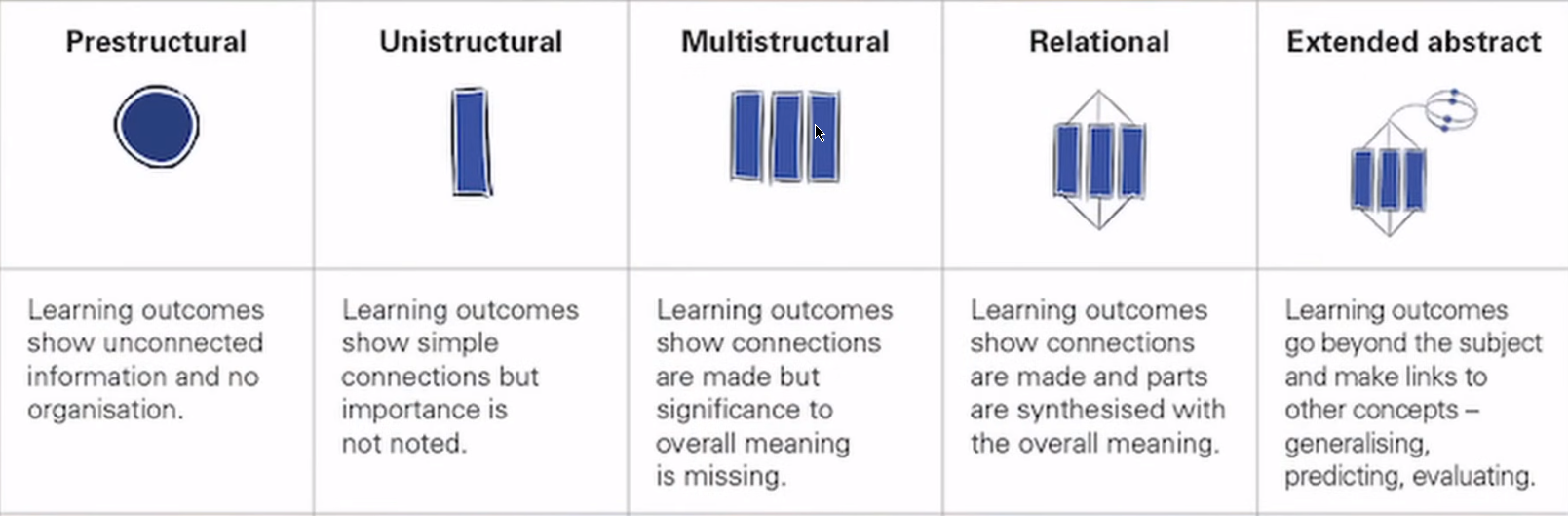
Solo taxonomy - fonte - kill linearility
- Extended abstract - relations to the big picture
- relations & info goes beyond the same field
- current field + diff fields + past knowledge
- e.g.
- choosing a career based on Int, past knowledge, & any related field Predicting the best option
- making a video with music, 3d graphics, & educational content to teach X specifically
- studying a concept that encompass other fields like AI (Math, statistics, computer science, etc)
- can create new knowledge & apply t diff contexts (principles)
- deeper importancy/direction based on the broadest context
- the individual himself, everything he knows, and how this information can help based on all of that
- relations & info goes beyond the same field
- Relational - relations to topics & their same field
- relations & info within same field as a whole & its topics (sys)
- How a component fits optimally into a sys based on other components and the filet itlsef (sys)
- e.g.
- why git’s essential & how it fits optimally in the workflow based on system (like choosing Gitflows)
- making a great art painting using the knowledge learned specifically for art & no other fieldsz
- importancy/direction - which topic is most important
- context - how it works within the whole (sys)
- relations & info within same field as a whole & its topics (sys)
- low level
- Multistructural - relations to concepts & its topic
- shallow relations & info within concepts of same topic
- narrow view, context lost ignoring where it fits
- in its own field and bigger picture
- Causality overlooked
- focuses quantity of knowledge, not depth
- e.g.
- knowing every component of a computer but not how they work togheter to make it function
- narrow view, context lost ignoring where it fits
- shallow importancy/direction from the context of topic
- shallow relations & info within concepts of same topic
- Unistructural - relations to small parts & its main concept
- topic & field overlooked, almost no context or relations
- e.g.
- war of X happened in Y and Z people died
- e.g.
- importancy/direction almost non-existant
- memorization used more than processing
- quality & quality of knowledge lacking
- topic & field overlooked, almost no context or relations
- Prestructural - isolated, not understood, bit of knowledge
- Multistructural - relations to concepts & its topic
- img - (descriptions not so precise)
- Extended abstract - relations to the big picture